


Age alone does not decide whether a wisdom tooth needs to come out. If you’re considering wisdom teeth removal in your 30s, the decision depends more on the health and position of your third molars than your age.
What matters more is what’s happening with that tooth right now: is it pressing on a neighbor, showing up as a shadow on an X-ray, or staying tucked away where it can be kept clean?
If you’re in this situation, you’re far from alone. Many adults never had their wisdom teeth removed as teenagers, and some only find out they have a problem tooth when a dentist spots something during a routine checkup years later.
Whether you need extraction now depends on your symptoms, your X-ray findings, and how that tooth sits next to the teeth around it, not on the number on your birth certificate.
The rest of this article walks through how dentists and oral surgeons weigh those factors, and what changes about the procedure and recovery once you’re past your 20s.
Key Takeaways
- A wisdom tooth that is healthy, fully grown in, and easy to clean often does not need removal, regardless of your age.
- Pain, swelling, repeated infection, or X-ray findings like cysts and bone loss are signs your dentist should evaluate soon.
- Extractions in your 30s and 40s are routine, though denser bone and fully formed roots often call for more detailed imaging and a longer healing window.
When Removal Is Recommended After 30 or 40
Removal becomes the right call when a wisdom tooth is actively causing damage or showing clear warning signs, not simply because it’s still there.
Dentists look at pain, infection history, crowding, and what shows up on imaging before recommending wisdom teeth removal at any age.
According to the American Dental Association, extraction is often recommended when there is pain near the wisdom tooth, repeated infection of the gum tissue behind the last molar, cysts, tumors, damage to nearby teeth, gum disease, or widespread decay.
A tooth that has grown in fully, sits in the right position, bites correctly, and can be cleaned daily may not need to come out at all.
Symptoms That Need a Dental Assessment
Persistent jaw pain, swelling near the back of the mouth, or a bad taste that won’t go away are reasons to call your dentist.
These can point to infection around a partially erupted or impacted wisdom tooth, one that hasn’t fully broken through the gum.
Repeated soreness in the same spot, difficulty opening your mouth fully, or gum tenderness that flares up every few months also deserve a look.
These symptoms tend to repeat and worsen without treatment.
Problems an X-Ray Can Reveal Without Pain
A dental X-ray can catch trouble before you ever feel it. Cysts, which are fluid-filled sacs that can form around an impacted tooth, sometimes grow for months without any pain, and left alone they can damage the roots of nearby teeth or lead to bone loss in the jaw.
X-rays can also show crowding pressure against the second molar, decay in a spot too far back to see in the mirror, or early bone changes around the tooth.
This is why routine dental checkups matter even when nothing hurts.
When Monitoring May Be Reasonable
A wisdom tooth that is fully erupted, positioned well, and easy to keep clean can often be watched instead of removed.
Your dentist may recommend periodic X-rays to track its position and confirm the surrounding bone and gum health stay stable over time.
Monitoring works best when you keep up with regular cleanings and checkups, since new problems can develop gradually.
If your circumstances or symptoms change, your dentist can revisit the conversation about wisdom teeth removal.
How Age Can Affect Extraction and Healing
Extractions in your 30s and 40s are safe and common, but the surgery itself tends to be more involved than it would have been at 18.
Bone density increases with age, and tooth roots finish developing, both of which change how an oral surgeon approaches the procedure.
Why Roots and Bone Can Make Adult Extractions More Complex
Fully formed roots and denser jawbone make adult extractions more technically demanding than teen extractions.
In a teenager, wisdom tooth roots are still developing and the surrounding bone is softer, so the tooth tends to come out with less resistance.
By your 30s or 40s, the roots are fully developed and may sometimes be curved, while the surrounding bone is more mature.
Depending on the tooth’s position and proximity to nearby structures, your dentist or oral surgeon may recommend more detailed imaging for surgical planning.
What Influences Healing Time
Healing time depends on how impacted the tooth was, your overall oral health, and how closely you follow aftercare instructions.
Many adults need about one to two weeks for initial healing, with the most discomfort and swelling in the first three to five days.
Younger patients sometimes bounce back in a few days, while older adults may need closer to a week or more before they feel fully normal.
Bone itself continues healing quietly for months after the visible soreness fades.
Risks to Discuss Before Oral Surgery
Every extraction carries some risk, and it’s worth talking through these with your oral surgeon beforehand.
Dry socket, a condition where the blood clot at the extraction site comes loose too early and exposes bone and nerve endings, is one of the more common complications and tends to cause sharp pain a few days after surgery.
Other things worth asking about include nerve proximity (especially for lower wisdom teeth near the jaw nerve), sinus involvement for upper teeth, and how any existing health conditions, like diabetes or blood thinner use, might affect healing.
A thorough consultation before oral surgery helps you go in with clear expectations.
What to Expect From Evaluation Through Recovery
A wisdom tooth evaluation starts with imaging and a conversation about your options, then moves through the procedure itself and a defined recovery window.
Knowing what happens at each stage makes the whole process feel less uncertain.
Choosing Between a Dentist and an Oral Surgeon
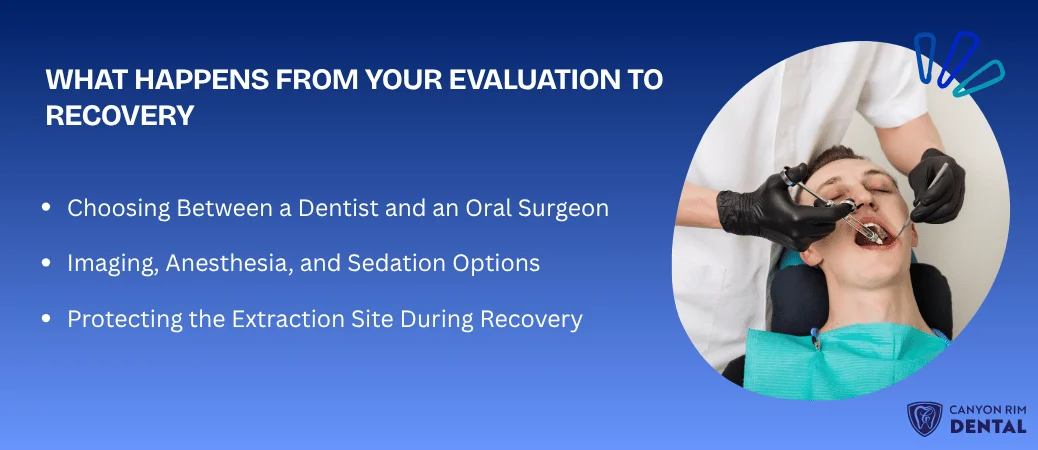
Many general dentists handle straightforward wisdom tooth extractions, while an oral surgeon typically handles impacted or more complex cases.
If your tooth is fully erupted and simple to access, your regular dentist may be able to remove it in-office.
If imaging shows an impacted tooth, curved roots, or close proximity to a nerve, your dentist will likely refer you to an oral surgeon for wisdom teeth extraction.
Oral surgeons have more advanced training and equipment for handling these harder cases safely.
Imaging, Anesthesia, and Sedation Options
Detailed imaging, often a 3D scan, lets the surgical team map out root position and nerve location before your appointment.
This planning step matters more for adults than it did in the teen years, since roots are fully formed and denser bones can obscure detail on a standard X-ray.
For anesthesia and sedation, options usually range from local numbing alone to oral sedation or IV sedation, depending on how complex the extraction is and your comfort level.
Your dentist or oral surgeon will walk through which option fits your case during your consultation, so you know what to expect before you’re in the chair.
Protecting the Extraction Site During Recovery
Careful aftercare in the first few days protects the blood clot and lowers your risk of dry socket.
Avoid straws, smoking, and vigorous rinsing for the first 24 hours, since suction can dislodge the clot before it has time to stabilize.
Gentle oral hygiene, like rinsing carefully with warm salt water after the first day, helps keep the extraction site clean without disturbing healing tissue.
Sticking to soft foods, avoiding the surgical side when chewing, and keeping up with any prescribed rinses all support steady gum health as the site closes.
Making a Decision Based on Your Teeth and Health

The right choice comes down to your specific tooth, your symptoms, and your overall oral health, not a general rule about age.
A wisdom tooth that’s healthy, well-positioned, and easy to clean can often stay put with regular monitoring.
A tooth causing pain, showing cyst formation, or crowding its neighbor is a different story, and waiting can allow the problem to grow.
Bring any new symptoms or X-ray findings to your dentist and ask direct questions about what they’re seeing and why they’re recommending a particular path.
Your dentist knows your dental history and can weigh your individual risk factors better than any general guideline.
That conversation, not your age, should guide what happens next.
Frequently Asked Questions
Is it too late to remove wisdom teeth in your 40s?
No, it is not too late. Extractions in your 40s are routine and successful for most patients, though the surgery may require more detailed imaging and a longer recovery window than it would have in your teens or 20s.
Should wisdom teeth be removed if they do not hurt?
Not always. A wisdom tooth that’s fully grown in, positioned correctly, and easy to clean can often be left alone and simply monitored with routine dental visits and X-rays.
Removal becomes more likely if imaging shows a cyst, bone loss, or pressure against a neighboring tooth, even without pain.
Why are wisdom teeth harder to remove after age 30?
Bone density increases and tooth roots finish forming by the time most people reach their 30s, which makes extractions more surgically complex than they would be in a teenager.
This is why oral surgeons often rely on 3D imaging and more detailed planning for adult cases.
How long does recovery take after wisdom tooth removal for adults?
Most adults need about one to two weeks for initial healing, with the worst swelling and discomfort in the first three to five days.
Full bone healing underneath the gum continues for several weeks to months after the visible discomfort fades.
Can an impacted wisdom tooth cause damage without symptoms?
Yes. An impacted tooth can form a cyst or put pressure on a neighboring tooth’s root for months before any pain shows up, which is why dental X-rays are important even when nothing feels wrong.
Catching these changes early can prevent more extensive treatment later.