



When your dentist tells you a tooth is badly damaged or infected, you face a big decision.
Root canal treatment saves your natural tooth by removing the infected tissue inside, while dental extraction removes the entire tooth from its socket.
Both options stop infection and pain, but they work in very different ways and have different effects on your oral health.
The choice between a root canal vs tooth extraction in Salt Lake City isn’t always simple. You need to think about how much healthy tooth structure remains, the long-term costs, and what happens after treatment.
In Salt Lake City, patients work with their dentists to figure out which option makes the most sense for their situation. Making the right choice affects more than just your wallet.
At Canyon Rim Dental, Dr. Sam Delahunty and Dr. Mark Soffe take the time to evaluate each patient’s condition, concerns, and long-term oral health before recommending treatment. Whenever possible, the goal is to preserve your natural tooth, but extraction may be the better option when a tooth is too damaged or infected to restore successfully.
Your decision can affect more than your immediate dental costs. It may influence how comfortably you chew, how your smile looks, and whether nearby teeth remain properly aligned. This guide explains when saving a tooth with root canal treatment may make sense and when extraction could be the more appropriate path forward.
Key Takeaways
- Root canals preserve your natural tooth while extractions require replacement options like implants or bridges
- Saving a tooth with root canal therapy is often less expensive long-term than extraction plus replacement
- Recovery time and comfort levels differ between procedures, with factors like tooth location affecting your experience
Table of Content
- Understanding Root Canal Treatment and Tooth Extraction
- When to Save a Tooth vs. When to Extract
- Comparing Costs and Treatment Outcomes
- Tooth Replacement Options After Extraction
- Choosing the Right Dental Specialist in Salt Lake City
- What to Expect During Recovery and Aftercare
- Frequently Asked Questions
Understanding Root Canal Treatment and Tooth Extraction
When your dentist mentions these procedures, they’re talking about two different ways to handle a damaged or infected tooth.
Root canals save your natural tooth by cleaning out the infection, while extraction removes the entire tooth from your mouth.
What Is a Root Canal?
A root canal is a treatment that saves your natural tooth when the inner pulp becomes infected or damaged. The pulp is the soft tissue inside your tooth that contains nerves and blood vessels.
Endodontic therapy removes this diseased pulp while keeping your tooth structure intact. Your dentist creates a small opening in your tooth to access the infected area.
They clean out all the bacteria and damaged tissue from the inside.
After cleaning, they fill and seal the tooth to prevent future infections. Most root canals have a 95% success rate at saving teeth long-term.
The Root Canal Procedure Explained
Your dentist starts the root canal procedure by numbing the area around your tooth. You won’t feel pain during the treatment because of local anesthesia.
They place a rubber sheet called a dental dam around your tooth to keep it dry and clean. A small opening is made in the top of your tooth to reach the pulp chamber.
Special instruments remove the infected or damaged pulp from inside the tooth and root canals.
The empty space gets cleaned thoroughly with disinfecting solutions. Your dentist shapes the canal walls to prepare them for filling.
They fill the cleaned canals with a rubber-like material called gutta-percha.
A filling seals the opening until your next visit. You’ll return later to get a permanent crown placed on top to protect the tooth and restore its function.
What Is Tooth Extraction?
Tooth extraction means your dentist completely removes a tooth and its root from the bone socket in your jaw. This option eliminates the source of infection or damage by taking out the entire tooth.
Dentists recommend extraction when a tooth is too damaged to save with root canal treatment. Severe decay, advanced gum disease, or major fractures might make saving the tooth impossible.
After extraction, you’ll need to replace the missing tooth to prevent your other teeth from shifting.
Your bite alignment and ability to chew properly depend on maintaining the proper spacing in your mouth.
Tooth Extraction Procedure Types
Simple extraction works for teeth that are visible above your gum line. Your dentist numbs the area and uses special tools to loosen and remove the tooth.
This type takes less time and causes less discomfort during recovery.
Surgical extraction is needed for teeth that haven’t fully emerged or have broken at the gum line. An oral surgeon makes a small cut in your gum to access the tooth.
They might need to remove some bone around the tooth or cut it into smaller pieces for easier removal.
Both extraction types require local anesthesia to keep you comfortable. Surgical extractions typically need more healing time than simple extractions.
Your dentist will tell you which tooth extraction procedure you need based on your tooth’s condition and position.
When to Save a Tooth vs. When to Extract
The choice between saving a tooth and removing it depends on how much healthy tooth structure remains, the type of damage present, and whether the tooth can function long-term.
Dentists look at specific signs of infection, cracks, and prior treatments to determine which option gives you the best outcome.
Assessing Tooth Damage and Infections
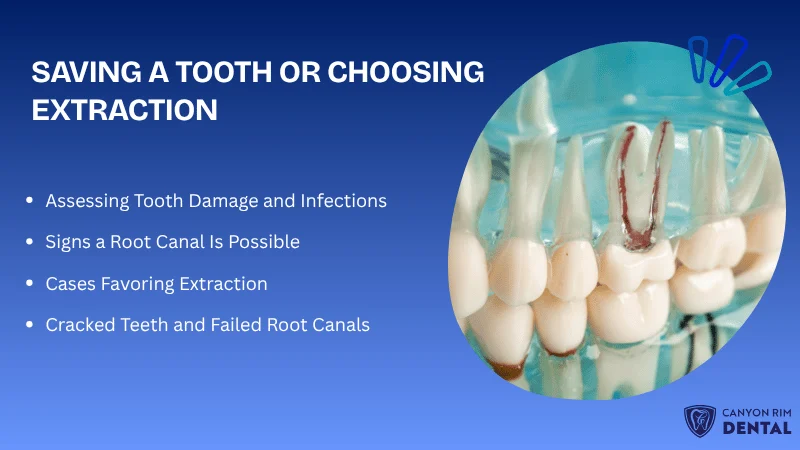
Your dentist will examine how far decay or infection has spread into your tooth. When bacteria reach the inner pulp chamber, the diseased pulp causes pain and swelling.
An X-ray shows whether the infection has reached the bone around your tooth roots.
The amount of healthy tooth structure above your gum line matters most. If most of your natural tooth remains intact, saving a tooth with a root canal becomes possible.
Your dentist checks whether enough tooth exists to support a crown after treatment.
Key factors dentists evaluate:
- Depth of decay into the tooth
- Extent of infection in surrounding bone
- Amount of natural tooth structure remaining
- Overall health of your gums and jawbone
Signs a Root Canal Is Possible
You can likely save your tooth when the damage stays within the crown portion and roots remain strong. A root canal removes infected tissue while keeping your natural tooth in place.
Good candidates for root canal vs extraction have solid root structure and enough tooth to attach a restoration.
An endodontist can perform the procedure to clean out the diseased pulp, disinfect the inner chambers, and seal the tooth.
Root canal recovery typically takes a few days with minimal discomfort. Your tooth remains functional for many years after treatment.
Most teeth treated by an endodontic specialist have success rates above 85% over ten years.
Cases Favoring Extraction
Some teeth cannot be saved even with advanced treatment. Severe vertical cracks that extend below your gum line make the tooth impossible to restore properly.
Extraction becomes necessary when:
- The tooth has fractured deep into the root
- Advanced gum disease has destroyed supporting bone
- The tooth lacks enough structure for a crown
- Repeated infections continue after prior treatments
Removing a badly damaged tooth prevents ongoing infections.
However, you’ll need to replace the missing tooth with an implant, bridge, or partial denture to maintain proper bite alignment and prevent other teeth from shifting.
Cracked Teeth and Failed Root Canals
A cracked tooth creates a difficult decision. Small cracks in the enamel can be monitored, but fractures extending into the pulp require immediate attention.
When you see an endodontist, they use special tools to identify crack depth and direction.
Vertical cracks that run from the chewing surface down through the root cannot be repaired. These teeth need extraction regardless of root canal treatment.
A failed root canal happens when infection returns or never fully heals. You might need retreatment by an endodontic specialist who can access missed canals or remove persistent bacteria.
If retreatment isn’t possible due to calcified canals or severe reinfection, extraction becomes your only option to eliminate the problem.
Comparing Costs and Treatment Outcomes
A root canal with a crown typically costs $1,500 to $3,100 total, while extraction with implant replacement often runs $3,000 to $6,500 or more.
The treatment you choose affects not only your wallet today but also your chewing function and dental expenses for years to come.
Root Canal and Crown Costs
Root canal cost varies based on which tooth needs treatment. Front teeth are simpler and typically cost $700 to $1,200 for the root canal procedure itself. Back teeth with multiple roots cost more, usually $1,000 to $1,500.
You’ll also need a crown to protect the treated tooth. Crown cost adds another $800 to $1,600 to your total expense.
This means your complete root canal costs will range from $1,500 to $3,100 when you add both procedures together.
Some teeth require specialist care from an endodontist. This might increase your root canal cost by $200 to $500, but specialists have advanced training that can save teeth that general dentists cannot treat.
Extraction Costs and Tooth Replacement
Tooth extraction cost seems much lower at first glance. A simple extraction ranges from $150 to $500. This makes extraction look like the budget-friendly choice.
The real expense comes after the tooth is gone. You have three main replacement options. A dental bridge requires grinding down the neighboring teeth and costs $2,500 to $5,000.
A partial denture runs $300 to $1,800 but moves when you eat. A dental implant provides the most natural replacement at $3,000 to $6,500.
When you add replacement costs to the extraction cost, saving your tooth with a root canal usually costs less over time.
Leaving a permanent gap without replacement causes neighboring teeth to shift and creates bite problems.
Long-Term Value and Chewing Function
Your natural tooth provides better chewing function than any replacement. Root canal recovery takes about one week before you can chew normally on that tooth.
The treated tooth functions just like your other natural teeth once healed.
Extraction recovery takes longer because your jawbone needs time to heal. You’ll avoid that area when eating for two to four weeks. Extraction pain typically peaks on day two or three, then gradually improves.
If you choose an implant, you’ll wait three to six months for the bone to fuse before getting the final crown. During this time, your chewing function remains limited on that side.
A bridge or denture provides faster results but never quite matches the stability of a natural tooth.
Natural teeth also help maintain your jawbone density. When you lose a tooth, the bone in that area starts to shrink. This changes your facial structure over time.
Dental Insurance Considerations
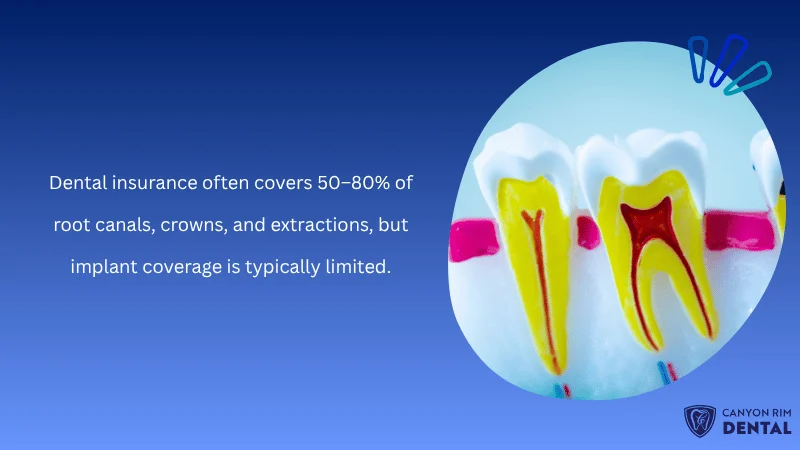
Most dental insurance plans cover 50% to 80% of root canal costs after your deductible. They typically also cover 50% of crown cost, though some plans classify crowns as major work with a waiting period.
Insurance usually covers tooth extraction cost at 50% to 80% as well. However, coverage for tooth replacement varies widely.
Many plans cover bridges at 50%, but implants often receive little to no coverage because insurance companies consider them cosmetic.
Your annual maximum benefit limit matters too. Most plans cap coverage at $1,500 to $2,000 per year. A root canal and crown might reach this limit in one year.
An extraction plus implant will definitely exceed it, meaning you’ll pay more out of pocket or spread treatment across two benefit years.
Check your financing options and insurance plan before deciding. Some employers offer plans with higher maximums or separate allowances for major work.
Tooth Replacement Options After Extraction
After removing a tooth, you have three main ways to fill the gap: implants, bridges, or partial dentures. Each option has different costs, time requirements, and effects on your remaining teeth.
Dental Implants and Bone Grafting
A dental implant is a titanium post that goes into your jawbone to replace the tooth root. Your dentist surgically places the implant, and after a few months of healing, they attach a crown on top.
This creates a replacement that looks and works like your natural tooth.
Many patients need a bone graft before getting an implant. When you lose a tooth, the jawbone in that area starts to shrink because it no longer gets pressure from chewing.
A bone graft adds material to rebuild the bone so it can support the implant.
The process takes several months from start to finish. You’ll need time for the bone graft to heal, then more time for the implant to fuse with your bone. After that, your dentist can place the final crown.
Implants cost more upfront than other options. The total price usually ranges from $3,000 to $6,500 or more per tooth.
But implants can last 20 years or longer with good care, which makes them a solid long-term choice.
Dental Bridges and Fixed Options
A dental bridge uses the teeth on either side of the gap to support a replacement tooth in the middle. Your dentist reshapes the neighboring teeth and places crowns on them. These crowns hold the bridge in place.
Fixed bridges stay in your mouth permanently. You can’t take them out, and you care for them like natural teeth.
A fixed bridge cost typically runs $2,000 to $5,000 depending on the materials and how many teeth need crowns.
The downside is that your dentist must alter healthy teeth next to the gap. They’ll remove enamel from these teeth to fit the crowns. This can weaken them over time.
Bridges work well if the teeth on both sides of the gap are already damaged or have large fillings. They’re faster than implants since you can get them in just a few weeks.
Most bridges last 10 to 15 years before needing replacement.
Partial Dentures and Their Role
A partial denture is a removable appliance that fills in one or more missing teeth. It has replacement teeth attached to a plastic or metal base. Small clasps hook onto your natural teeth to keep it in place.
You take partial dentures out at night for cleaning. They’re the most affordable tooth replacement option, usually costing $500 to $2,000. This makes them good for patients who can’t afford implants or bridges right away.
Partials work best as a temporary solution. They can move around when you eat or talk, and some people find them uncomfortable.
The clasps may also show when you smile, depending on where the missing tooth is located.
Over time, partial dentures can put pressure on the teeth they clip onto. You’ll need adjustments every few years as your gums and bone change shape.
Many patients use partials while saving money for a more permanent option like an implant.
Choosing the Right Dental Specialist in Salt Lake City
Finding the right specialist can make a big difference in your treatment outcome and comfort level. Endodontists focus on saving teeth, while oral surgeons handle extractions and more complex procedures.

Role of an Endodontist
An endodontist is a specialist trained to evaluate whether your tooth can be saved. These dentists complete two to three additional years of education after dental school focusing specifically on the inside of your tooth.
When you see an endodontist, they use advanced tools and techniques that most general dentists don’t have in their offices.
They perform root canals every day, which means they have more experience with these procedures than a general dentist would.
Your regular dentist will usually refer you to an endodontic specialist when they find infection or damage to the tooth’s pulp.
Getting a second opinion from an endodontist is worth considering before choosing extraction, especially if you want to keep your natural tooth.
When to Consult an Oral Surgeon
You’ll need to consult an oral surgeon if extraction is the recommended treatment option. Oral surgeons handle the complete removal of teeth and can manage more complicated cases.
These specialists are necessary when teeth are severely damaged, broken below the gum line, or impacted.
They also perform bone grafts and place dental implants if you decide to replace the extracted tooth later.
Your general dentist or endodontist will refer you to an oral surgeon when they determine the tooth cannot be saved.
Some patients need to see both specialists—first an endodontist to confirm the tooth is beyond saving, then an oral surgeon for the extraction.
How to Find the Right Specialist
When you need to find an endodontist or oral surgeon, start by asking your general dentist for referrals. Your dentist knows which specialists have good reputations and work well with patients.
Check online reviews from other patients to get a sense of the office environment and treatment experience. Look for specialists who explain procedures clearly and make you feel comfortable asking questions.
Key factors to consider:
- Years of experience with your specific procedure
- Office location and availability for emergency visits
- Insurance acceptance and payment options
- Technology and equipment used
- Staff friendliness and communication style
Call the office before scheduling to confirm pricing and ask about their approach to treatment.
Most specialists in Salt Lake City offer consultation appointments where you can meet the doctor and get your questions answered before committing to treatment.
What to Expect During Recovery and Aftercare
Root canal recovery typically involves mild discomfort for a few days, while extraction healing takes longer and carries risks like dry socket. Both procedures require specific aftercare steps to ensure proper healing.
Root Canal Recovery and Aftercare
You can expect mild to moderate discomfort for 2-3 days after your root canal. Most patients return to work the next day and manage any pain with over-the-counter medications like ibuprofen.
Your tooth may feel sensitive when you bite down for the first week. This is normal and should gradually improve. Avoid chewing on that side of your mouth until you get your permanent crown placed.
Key aftercare steps include:
- Take pain medication as directed by your dentist
- Brush and floss gently around the treated tooth
- Avoid hard or sticky foods for several days
- Attend your follow-up appointment to get your crown
The recovery time for root canals is usually shorter than extractions. Root canals have a 95% success rate when you follow proper aftercare instructions.
Extraction Healing and Risks Like Dry Socket
Extraction recovery takes longer than root canal healing. You’ll have a blood clot form in the empty socket within the first 24 hours. This clot protects the bone and nerves underneath.
Dry socket occurs when this blood clot dislodges or dissolves too early. It affects about 2-5% of extraction patients and causes severe pain 3-4 days after the procedure.
You’ll need to see your dentist immediately if you develop this complication.
To prevent dry socket:
- Don’t use straws for 72 hours
- Avoid smoking or vaping
- Don’t rinse your mouth vigorously
- Skip hard or crunchy foods for one week
Swelling and bruising are common after extractions. Apply ice packs for the first 24 hours and switch to warm compresses after that. Your socket will take 1-2 weeks to close and several months for the bone to fully heal.
Timeline for Returning to Normal Activities
After a root canal, you can resume most normal activities within 24 hours. Eat soft foods for 2-3 days and avoid chewing directly on the treated tooth. Most people return to work the next day.
Extraction recovery requires more time off. Plan to rest for 2-3 days after the procedure. Avoid exercise and heavy lifting for one week to prevent bleeding.
You can return to eating regular foods after 7-10 days with an extraction. Start with soft foods like yogurt, mashed potatoes, and scrambled eggs. Gradually add firmer foods as your socket heals.
Schedule your crown placement 2-4 weeks after a root canal. For extractions, wait 3-6 months before getting an implant or bridge to allow complete bone healing.
Frequently Asked Questions
Patients dealing with damaged or infected teeth often have similar questions about treatment options, pain relief, and whether their natural tooth can be saved.
The answers depend on the condition of your tooth, the extent of damage, and your long-term oral health goals.
How do I know whether a root canal or an extraction is the better choice for my tooth?
Your dentist will examine the tooth’s structure and take X-rays to see how much healthy tooth remains. If the tooth has enough structure to support a crown after treatment, a root canal is usually the better option.
Your dentist also checks if the infection has spread to the bone or if the tooth root is cracked.
The decision also depends on whether you’re willing to replace the tooth after extraction. Replacing a tooth with an implant or bridge requires extra appointments and procedures.
Saving your natural tooth with a root canal often costs less and preserves your jawbone better than extraction and replacement.
Your overall health matters too. Some medical conditions make healing from surgery more difficult, which could influence the choice.
Will having a tooth extracted stop the pain right away?
Extraction removes the source of infection, but you’ll still have pain during recovery. The area where the tooth was removed needs time to heal. You might feel discomfort for several days to a week after the procedure.
Tooth extraction is often more painful than the infection itself. The procedure involves removing the entire tooth and its attachment from the bone socket. This creates a wound that takes time to close and heal.
Root canals actually cause less discomfort during recovery than extractions in most cases.
The procedure removes the infected nerve tissue that’s causing your pain, and you keep your natural tooth structure intact.
Can a broken or badly decayed tooth still be saved with a root canal?
It depends on how much tooth structure remains above the gum line. Your dentist needs enough healthy tooth to attach a crown after the root canal.
If decay has destroyed most of the tooth down to the gum, saving it becomes much harder.
The location of the break matters. A crack that goes down into the root usually means the tooth can’t be saved. Surface cracks or breaks in the crown portion can often be repaired after root canal treatment.
Your dentist will check if the tooth root itself is still healthy and firmly attached to the bone.
Even teeth with significant damage can sometimes be saved if the root and surrounding bone are in good condition.
If my tooth is cracked, do I need a crown, a root canal, or both?
Small cracks in the outer enamel might only need a crown to protect the tooth from further damage.
If the crack reaches the pulp chamber where the nerve lives, you’ll need a root canal first to remove the infected tissue. Then you’ll get a crown to seal and strengthen the tooth.
Vertical cracks that run down through the root can’t be fixed. These teeth usually need extraction because the crack allows bacteria to keep entering the tooth.
Your dentist will use special tools and X-rays to see how deep the crack goes. The treatment plan depends entirely on whether the crack has exposed or damaged the nerve.
What are the pros and cons of keeping a tooth with a root canal versus removing it and replacing it later?
Keeping your tooth preserves your natural bite and prevents other teeth from shifting. Root canals have a 95% success rate and let you keep your original tooth and bone structure.
You avoid the need for bone grafts or other procedures that might be required before placing an implant.
The main downside is that a root canal plus crown costs money upfront. The tooth also becomes more brittle over time since it no longer has a blood supply.
Extraction seems simpler at first, but replacing the missing tooth requires additional visits and procedures.
Implants require surgery and several months of healing before you get the final crown. Bridges require grinding down healthy neighboring teeth. Leaving the space empty causes teeth to shift and creates bite problems.
Long-term, saving your natural tooth usually costs less than extraction plus replacement. Nothing functions quite like your original tooth.
Does getting a root canal mean the tooth is “dead,” and is it still worth saving?
The tooth loses its blood supply and nerve after a root canal, so technically it’s not alive anymore.
But the tooth is still firmly attached to your jawbone through the root and ligament. It can still sense pressure when you bite down.
A root canal tooth can last for decades with proper care. You need to brush and floss it just like your other teeth. The crown protects it from breaking since the tooth becomes more brittle without moisture from the inside.
Your natural tooth still looks, feels, and functions better than any replacement. It preserves the bone in your jaw, which naturally shrinks after tooth extraction.
This makes root canal treatment worth it for most people who want to keep their natural smile and bite.