

A chipped tooth or a knocked-out tooth can happen in seconds, and what you do next really matters.
Your best chance of saving a knocked-out permanent tooth is to keep it moist and get to an emergency dentist in Salt Lake City within 30 minutes.
Whether you’re at a Salt Lake City park, on the ski slopes, or just at home in the kitchen, staying calm and knowing the right steps can make all the difference for your smile.
Dental emergencies feel scary, but you don’t have to guess what to do.
This guide walks you through a simple 30-minute checklist so you know exactly how to handle a knocked-out tooth, care for a chip or crack, and figure out when your child’s baby tooth needs different treatment.
You’ll also learn what happens once you reach the dentist, so you feel prepared instead of panicked.
Every minute counts during that first 30-minute window, so it helps to know your options before an emergency ever happens.
Keep reading to learn how to store a knocked-out tooth safely, care for chipped or broken teeth, and find trusted emergency dental help near you in Salt Lake City.
Key Takeaways
- Acting quickly and calmly in the first half hour after a dental injury gives you the best shot at saving your tooth.
- How you store a knocked-out tooth, and whether it’s a baby tooth or adult tooth, changes what steps you should take.
- Getting to an emergency dentist quickly helps them decide the right treatment for chips, cracks, or full tooth loss.
Act Fast: Your First 30-Minute Checklist
The first 30 minutes after a dental injury matter more than you might think, and a few simple steps can protect your safety and improve your chances of saving a tooth. Here’s what to check, do, and watch for right away.
Check for Serious Injuries First
Before you worry about the tooth, check your whole body for signs of a bigger problem. A hard hit to the mouth can also cause a head injury, so look for confusion, dizziness, or trouble remembering what happened.
These can be signs of a concussion.
Also check your jaw. If you can’t open or close your mouth normally, or if your bite feels off, you may have a broken jaw.
Any loss of consciousness, even for a few seconds, means you need to go to the emergency room, not just an emergency dentist. The same goes for a suspected broken jaw or serious head injury.
These situations need medical attention first, before anyone deals with the tooth itself.
Rinse the Mouth and Find Any Tooth Pieces
Once you know you’re safe, gently rinse your mouth with warm water to clear away blood and debris. Don’t scrub or swish hard, since this can disturb the injured area and make bleeding worse.
Next, look around for the tooth or any broken pieces. Check the ground, your clothing, and even inside your mouth, since small fragments can get stuck near the cheek or gums.
If you find the whole tooth, pick it up by the crown, which is the top part, and avoid touching the root. Keep it moist in milk or saliva.
If you only find pieces, save them anyway and bring them with you, since a dentist may still be able to use them for repair.
Control Bleeding and Reduce Swelling
To control bleeding, fold a piece of clean gauze or a clean cloth and press it firmly against the injured area. Hold steady pressure for about 10 to 15 minutes without checking too often.
If bleeding hasn’t slowed down after that time, or seems to be getting heavier, this counts as uncontrolled bleeding, and you should head to the emergency room.
For facial swelling, hold a cold compress against your cheek near the injury for 15 to 20 minutes at a time. Give your skin a short break between icing sessions to avoid irritation.
This simple step can also help ease pain while you get ready to seek care.
Call for Same-Day Emergency Dental Care
Once bleeding and swelling are under control, call an emergency dentist right away.
Same-day emergency dental care may be necessary for this type of injury, so contact Canyon Rim Dental as soon as possible rather than waiting until tomorrow.
Explain clearly what happened, whether you have the tooth or pieces, and how long ago the injury occurred. This helps the emergency dental care team prepare before you even arrive.
If you’re not sure whether your situation needs a dentist or a trip to the emergency room, it’s okay to call either one first. They can help you figure out the safest next step based on what you describe over the phone.
Saving a Knocked-Out Permanent Tooth
A knocked-out permanent tooth can often be saved if you know how to handle it correctly in the first few minutes. The way you pick it up, clean it, and store it makes a big difference in whether replantation works.
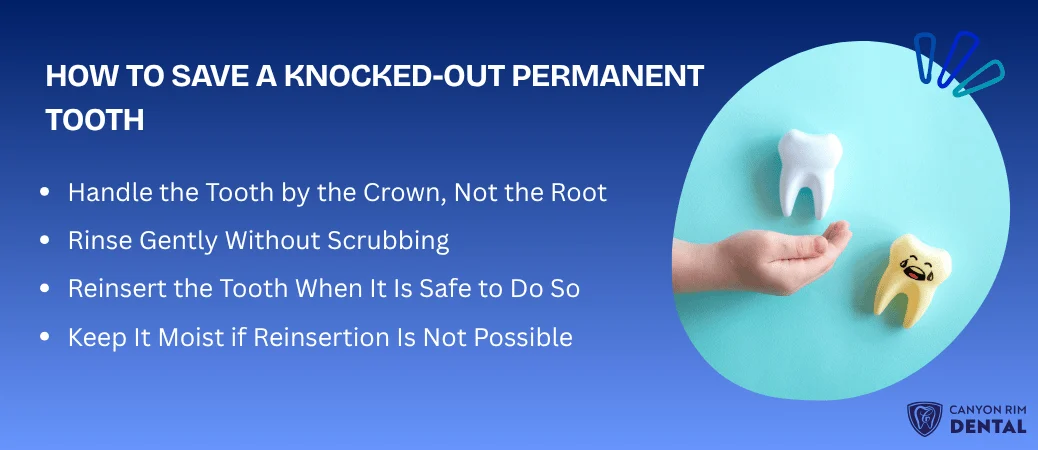
Handle the Tooth by the Crown, Not the Root
When you pick up an avulsed tooth, only touch the crown. That’s the white part you normally see when you smile.
Avoid touching the tooth root at all costs. The root is covered in periodontal ligament cells that help the tooth reattach to your jawbone.
These root surface cells are fragile, and rubbing or squeezing them can kill them. If they die, your dentist has a much harder time getting the tooth to survive long term.
Think of the root like the roots of a plant. You wouldn’t grab a plant by its roots and rub dirt off with your fingers, and the same care applies here.
Rinse Gently Without Scrubbing
If the tooth looks dirty, you can rinse it off, but you have to be careful about how you do it.
Hold the tooth by the crown and run it under cool, clean water for a few seconds. Milk works too if you have it nearby.
Never scrub the tooth with a cloth, gauze, or your fingers. Don’t use soap, alcohol, or any cleaning products either.
Don’t dry the tooth off with a towel. A quick, gentle rinse is enough to remove visible dirt without damaging the cells that keep the tooth alive.
Reinsert the Tooth When It Is Safe to Do So
If you can do it calmly and the person is old enough to cooperate, try placing the tooth back into its socket right away.
Gently push the tooth back into the empty space using light, steady pressure. It should slide in facing the same direction it came out.
Once it’s in place, have the person bite down softly on a clean cloth or gauze to hold it steady. This step gives the tooth the best shot at tooth survival because it keeps the root connected to the socket.
Don’t force it if it doesn’t go in easily. Skip this step for baby teeth or if you’re unsure, and move straight to storage instead.
Keep It Moist if Reinsertion Is Not Possible
If putting the tooth back in isn’t an option, the goal shifts to keeping it wet. Dry storage is one of the biggest reasons replantation fails, so avoid letting the tooth sit out in the open air.
Place the tooth in a small container of milk, since milk has the right balance of nutrients to keep the root cells alive. Saliva works as a backup if milk isn’t available.
Avoid tap water for storage, since it can actually damage the root cells over time. Every minute the tooth spends dry lowers your odds, so reducing dry time matters just as much as which liquid you choose.
Get to a dentist or emergency room fast for tooth preservation, since the sooner they can attempt reimplantation, the better your chances.
Choosing the Right Tooth Storage Method
How you store a knocked-out tooth can make or break your chances of saving it.
Some options keep the tooth’s cells alive, while others can damage it beyond repair, so it helps to know your choices before an emergency happens.
Why the Socket Is the Best Place for a Permanent Tooth
Your own mouth is the best storage spot for a knocked-out permanent tooth. If you can safely put the tooth back into its socket, do it right away.
The socket keeps the tooth moist and protects the periodontal ligament cells on the root surface. These cells help the tooth reattach to your jaw.
Hold the tooth by the crown, never the root, and gently push it back into place. Then bite down softly on a clean cloth or gauze to hold it there while you head to a dentist.
Best Alternatives: Tooth Preservation Solution and Cold Milk
If you cannot put the tooth back in place, reach for a proper tooth preservation product next. Brands like Save-a-Tooth use Hank’s Balanced Salt Solution, which is built to keep root surface cells alive for hours.
Cold milk is your best backup if you do not have a preservation kit on hand. Milk has a similar makeup to your body’s own fluids, which helps protect the tooth’s cells.
Here’s a quick ranking of your best options:
- Tooth socket (if reinsertion is possible)
- Tooth preservation product (like Save-a-Tooth)
- Cold milk
Avoid warm milk, since heat can speed up cell damage.
When Saliva or Saline Is an Acceptable Backup
No milk or preservation kit nearby? Saliva works as a decent short-term backup.
You can hold the tooth inside your cheek, between your cheek and gum. Just be careful not to swallow it.
Saline or saline solution is another safe choice if you have some handy. It will not preserve the tooth as long as milk or a preservation product, but it beats leaving the tooth dry.
Use saliva or saline only as a bridge until you can get cold milk, a preservation kit, or a dentist. Time still matters, so do not delay your trip just because you found an acceptable backup.
Why Tap Water and Dry Storage Can Harm the Tooth
Tap water and plain water are not good storage choices. Water can cause the root surface cells to swell and burst because it does not match the makeup of your body’s fluids.
Dry storage is even worse. Wrapping the tooth in a tissue or paper towel, or simply setting it on a counter, lets the root surface dry out fast.
Once those cells die, the tooth’s chances of successful reattachment drop sharply.
If milk, saliva, or saline are not available and reinsertion is not possible, plain water is only a last resort. Get to a dentist as quickly as you can, no matter which method you use for tooth preservation.
Chipped, Cracked, and Broken Tooth Care
A chipped tooth, cracked tooth, or broken tooth all need a slightly different response in the moments right after it happens.
Knowing how to protect the area, manage pain, and spot warning signs can help you avoid bigger problems later.
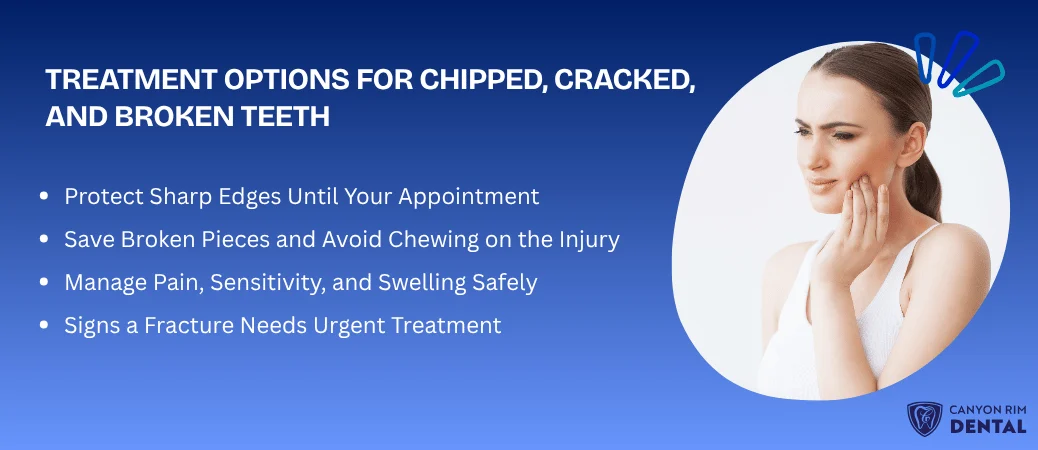
Protect Sharp Edges Until Your Appointment
A jagged edge from a chipped or cracked tooth can cut your tongue, cheek, or lip every time you talk or eat. You can cover the sharp spot with a small piece of dental wax to smooth it out temporarily.
Sugar-free gum works too if you don’t have wax on hand. Just press it gently over the rough area instead of chewing it.
Don’t try to file down the edge yourself with a nail file or other tool. This can chip the tooth further or damage the enamel around it.
If you have a dental emergency kit at home, dental wax is a good item to keep stocked for situations like this.
Save Broken Pieces and Avoid Chewing on the Injury
If a piece of your tooth breaks off, try to find it and keep it safe. Rinse it gently with water and store it in a small container or plastic bag.
Bring the piece with you to your dental appointment. In some cases, your dentist may be able to bond it back onto the tooth.
Avoid chewing on the injured side, even if it doesn’t hurt much. A loose tooth or weakened tooth can crack further under normal biting pressure.
Stick to soft foods like yogurt, mashed potatoes, or scrambled eggs until you’re seen. This gives the tooth a break and lowers your risk of making the damage worse.
Manage Pain, Sensitivity, and Swelling Safely
Pain from a broken tooth can range from mild to sharp and constant. Over-the-counter pain medication taken as directed on the label can help in the meantime.
Avoid placing aspirin directly against your gums or the tooth itself. This old trick doesn’t help and can actually irritate the tissue.
A cold compress held against your cheek can reduce swelling and ease discomfort. Try 15 minutes on, then a short break, rather than holding it in place nonstop.
If your tooth feels sensitive to hot, cold, or air, that’s often a sign the inner layers are exposed. Skip very hot or cold foods and drinks until your dentist checks it out.
Signs a Fracture Needs Urgent Treatment
Not every chip or crack needs a same-day visit, but some signs mean you shouldn’t wait. Call an emergency dentist right away if you notice any of the following:
- Ongoing bleeding that doesn’t slow down with light pressure from clean gauze
- Facial swelling or swelling that spreads beyond the immediate area
- A tooth that feels loose or shifted in its socket
- Pain that feels deep, intense, or gets worse instead of better
- Difficulty opening your mouth fully or biting down normally
These symptoms can point to a deeper fracture or infection risk that needs prompt attention. Because a cracked tooth cannot heal on its own, acting early usually means simpler treatment and a better outcome for your tooth.
Why Baby Teeth Need Different Care
Baby teeth are not just small versions of adult teeth, and they don’t need the same emergency steps.
If your child has dental trauma to a primary tooth, your goal shifts from saving that tooth to protecting the permanent tooth growing underneath it.
Do Not Reinsert a Knocked-Out Baby Tooth
If your child has a knocked-out baby tooth, don’t try to put it back in the socket. This is one of the biggest differences between baby teeth and adult teeth.
With a permanent tooth, quick reinsertion can save it. With a primary tooth, pushing it back in can actually cause harm.
Forcing a damaged baby tooth back into place can press against the permanent tooth bud and introduce bacteria, which may affect how the adult tooth forms later.
Instead, have your child rinse gently with warm water and use gauze to control any bleeding. Keep the tooth if you find it, but don’t attempt to reinsert it.
Protect the Developing Permanent Tooth
Every baby tooth sits directly above a developing permanent tooth. This is why baby tooth injuries need careful attention, even though they can look less serious than damage to an adult tooth.
The primary tooth acts like a placeholder and a shield for the tooth growing beneath it. Trauma to the root or socket can sometimes disturb that developing tooth, even if the injury seems minor on the surface.
A dentist will want to check for any signs that the injury reached deeper than the visible tooth. This helps rule out problems that could show up later, once the permanent tooth starts to come in.
When a Child Needs Prompt Dental Evaluation
Most knocked-out or chipped baby teeth are not true emergencies, but they still need a dental check fairly soon. You should aim to see a dentist within 24 hours in most cases.
You need urgent same-day care if:
- You can’t find the tooth after searching thoroughly
- Bleeding does not slow down after 10 minutes of gentle pressure
- Your child shows signs of a head injury
- There’s a large piece of tooth missing, exposing a pink or red center
For everyday chips or a single missing baby tooth with no other symptoms, a routine visit within a day is usually enough to make sure everything is healing the way it should.
What to Expect From Emergency Dental Treatment
Once you get to the dentist, your treatment plan will depend on how bad the damage is and how fast you get help. Here is what usually happens during your visit and what comes after.
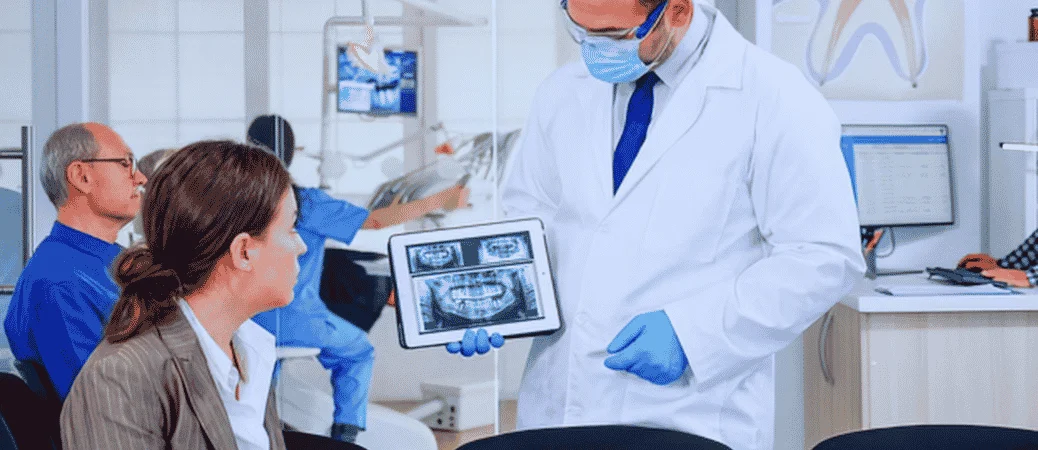
Examination, X-Rays, and Stabilizing a Replanted Tooth
Your dentist will start by looking at the injured area and taking X-rays. This helps them check for cracks below the gum line and see if the tooth root or jawbone was hurt.
If you have a knocked-out tooth that was put back in place, your dentist will likely splint it. A splint holds the tooth against nearby teeth so it can stay still while it heals.
The American Association of Endodontists notes that quick action and proper stabilizing greatly improve the chance the tooth will survive. You may need to wear the splint for one to two weeks.
Your dentist will also check for root resorption, a condition where the root slowly breaks down after an injury. This is one reason follow-up visits matter so much.
When Root Canal Treatment May Be Needed
If the injury reached the soft inner part of the tooth, called the pulp, you will likely need root canal treatment. This happens when a crack, chip, or knock-out exposes the nerve and blood vessels inside the tooth.
During root canal therapy, your dentist removes the damaged pulp, cleans the space inside the tooth, and seals it. This stops pain and prevents infection from spreading further.
Knocked-out teeth that are replanted often need root canal treatment within a few weeks, since the nerve usually cannot heal on its own once it is separated from its blood supply.
The International Association of Dental Traumatology recommends monitoring young patients’ teeth closely, since their root development can affect timing.
After the root canal is done, your dentist will usually cover the tooth with a crown to protect it from breaking again.
If the damage is extensive, your dentist may also help you compare root canal vs tooth extraction based on whether the tooth can still be saved.
Long-Term Monitoring and Tooth Replacement Options
Even after treatment, your dentist will want to see you again to check how the tooth is healing. This may include repeated X-rays over several months to watch for root resorption or other problems.
Sometimes a tooth cannot be saved, even with fast action and good care. In that case, your dentist will explain what to expect during a dental extraction and discuss your tooth replacement options.
Common replacement choices include:
- Dental implant – a titanium post placed in the jaw that supports a false tooth
- Fixed bridge – a false tooth held in place by the teeth next to the gap
- Denture – a removable option for replacing one or more teeth
Your dentist will help you pick the option that fits your budget, healing time, and long-term goals.
Preventing Future Sports-Related Dental Injuries
Many chipped and knocked-out teeth happen during contact sports like football, hockey, and basketball. Wearing a mouthguard is one of the easiest ways to lower your risk of a repeat injury.
Custom-fitted mouthguards from your dentist tend to protect better than store-bought ones, since they are shaped to match your teeth exactly.
If you grind your teeth at night, a night guard can also help prevent cracks and chips that build up over time.
The American Dental Association (ADA) recommends wearing mouthguards for any sport with a risk of contact or falls, not just football or hockey.
Regular dental checkups also let your dentist catch small cracks or weak spots before they turn into a bigger problem.
Frequently Asked Questions
If you or someone you love has a chipped or knocked-out tooth, you probably have a lot of questions. Here are quick answers to help you act fast and feel calmer during a stressful moment.
What should I do right away if my tooth is chipped or knocked out?
Stay calm and check for bleeding first. If a tooth is fully knocked out, time matters a lot, since cells on the root start to dry out fast once the tooth leaves your mouth.
This is why acting within the first 30 minutes gives you the best shot at saving it.
Pick up the tooth by the crown, not the root. Then get moving toward emergency dental care as quickly as you can.
How can I safely handle and store a knocked-out tooth before seeing a dentist?
Hold the tooth by the top part only. Avoid touching the root, since it’s delicate and easy to damage.
If you can gently place the tooth back into its socket, try to do that first. If that’s not possible, you’ll need a safe place to keep it moist during transport.
Following proper first aid steps for storage, like using milk or your own saliva, can help protect the tooth until you reach a dentist.
Should I rinse a knocked-out tooth, and what should I avoid touching?
You can give the tooth a quick, gentle rinse if it’s dirty, but skip the scrubbing. Never rub or scrape it to remove dirt or blood, since this can strip away cells the tooth needs to reattach.
Also avoid holding it under running tap water for too long. Too much tap water can actually kill root surface cells, which lowers the chance of a successful replant.
Can a dentist save a tooth if I get emergency care within 30 minutes?
Yes, in many cases a dentist can save a knocked-out tooth if you get help quickly. The faster you act, the better your odds.
A knocked-out tooth that’s kept moist and handled carefully has a real chance of being saved when treated fast. Waiting too long lowers your chances, so don’t delay.
When should I go to an emergency dentist versus the emergency room?
If it’s just a chipped, loose, or knocked-out tooth with no other injuries, an emergency dentist is usually your best bet. Dentists have the tools and training to handle tooth-specific problems.
Head to the ER instead if you have signs of a more serious injury, like heavy bleeding that won’t stop, a broken jaw, or a head injury.
When you’re not sure, it helps to treat the situation as urgent and call a dental professional right away for guidance.
Where can I find urgent dental care in Salt Lake City after a tooth injury?
Look for dental offices in the Salt Lake City area that offer same-day or emergency appointments. Many local practices keep slots open for urgent cases like a chipped or knocked-out tooth.
If your regular dentist’s office is closed, search for urgent dental care options nearby that can see you right away. Acting quickly and choosing a provider close to you can make a big difference in saving your tooth.