

If you’re over 60 and thinking about replacing a missing tooth, you may wonder if you’ve waited too long. It’s a fair question, since healing does slow down a bit as you get older.
Your age by itself doesn’t rule you out; bone quality, overall health, and medical history matter far more than the number of birthdays you’ve had.
That said, a few things do change after 60. Dental implant recovery may take a little longer, your dentist will look more closely at bone density and medications, and certain health conditions can affect how well the implant settles in.
Below, you’ll learn what to expect at each step, from your first consultation to protecting your new teeth for years of comfortable chewing.
Key Takeaways
- Your health and jawbone condition matter more than your age when it comes to implant eligibility.
- Expect a slightly longer healing timeline, plus extra checks on bone density and medications.
- Good daily care and regular dental visits help your implants last for many years.
Table of Content
- Age Is Not the Main Eligibility Factor
- Your Implant Consultation and Candidacy Assessment
- The Treatment Process and Recovery Timeline
- Managing Bone and Medication-Related Challenges
- Choosing the Right Restoration and Protecting Long-Term Results
- Frequently Asked Questions
Age Is Not the Main Eligibility Factor
Your birthday is not what decides whether implants will work for you. Bone volume, controlled health conditions, and daily oral care carry far more weight, and the research on older patients backs that up.
Is There an Age Limit for Dental Implants?
There is no upper age limit for dental implants. No regulatory body sets one, and no study has found a point where your body stops accepting an implant.
What matters is whether you can safely handle a minor oral surgery and heal afterward. Dentists have placed implants successfully in patients in their 65s-75s, often with high satisfaction.
Your dentist will look at:
- Jawbone volume in the planned implant site
- Blood sugar control if you have diabetes
- Smoking status, since it raises failure risk
- Medications, especially blood thinners and bone drugs
- Your ability to brush and clean around the implant
Age alone does not disqualify you from implant therapy. Unmanaged health problems can.
What Implant Survival Research Shows for Patients Over 65 and 75
Studies comparing age groups keep landing in the same place: older adults do about as well as younger ones.
Reported success rates for people 65 and older run roughly 92% to 98%, which lines up with figures for patients in their 30s and 40s.
Systematic reviews and meta-analyses of long-term data show 10-year implant survival in the mid-90% range across adult age groups.
For patients over 75, results stay strong, though there is more variation between individuals. Healing simply takes longer, and screening becomes more detailed.
When implant loss does happen in older patients, the cause is usually smoking, poor plaque control, or uncontrolled diabetes, not aging tissue. Success rates remain strong after 60 when those factors are managed.
How Implant Success Differs From Implant Survival
These two words get used as if they mean the same thing. They do not.
| Term | What it measures |
| Survival | The implant is still in your mouth and holding a crown or bridge |
| Success | The implant is stable and healthy: no pain, no looseness, no infection, and minimal peri-implant bone loss |
Success uses stricter rules. A common standard allows less than about 0.2 mm of bone loss per year after the first year of function.
So an implant can survive but not meet success criteria, which is why success percentages usually come in lower than survival percentages in the same study.
When you ask your dentist about numbers, ask which one they mean. Understanding what changes with age and what doesn’t helps you compare quotes and expectations honestly.
Your Implant Consultation and Candidacy Assessment
Your first visit is mostly information gathering. The dentist or oral surgeon checks how much jawbone you have, looks closely at your gums, reviews your medications and health history, and usually takes a 3D scan before suggesting any treatment plan.
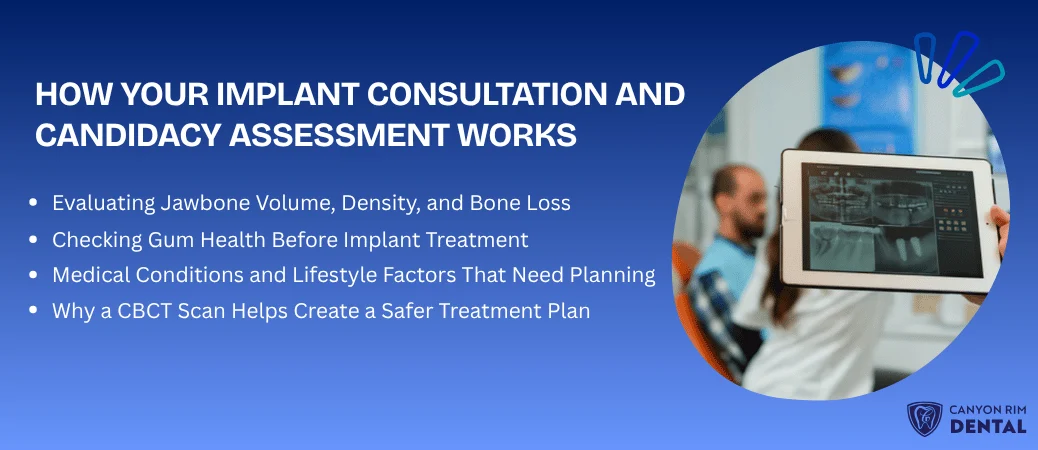
Evaluating Jawbone Volume, Density, and Bone Loss
An implant post needs enough bone to hold it steady while it fuses in place. So your surgeon measures both the height and width of bone at the site.
Jawbone loss starts soon after a tooth comes out, because the bone no longer gets pressure from a root. The longer the gap has been there, the more bone you may have lost.
Bone density for dental implants also becomes an important consideration with age, especially when determining whether the jaw can provide enough support. That does not end the conversation.
Common fixes include:
- Bone grafting to rebuild width or height
- Shorter or narrower implants that fit the bone you already have
- Sinus lift surgery for upper back teeth
- Angled placement to reach denser bone
Most concerns about bone density and implant candidacy get solved with planning rather than a flat no.
Checking Gum Health Before Implant Treatment
Healthy gums protect the implant the same way they protect a natural tooth. Your dentist will measure pocket depths, check for bleeding, and look for loose teeth or receding tissue.
Gum disease matters here because it is one of the main reasons teeth are lost in the first place.
Active periodontitis needs treatment before surgery. Bacteria that damage gums around teeth can also cause peri-implantitis, which loosens an implant over time.
Expect a deep cleaning, and possibly a few months of follow-up, before your surgeon gives the go-ahead.
Medical Conditions and Lifestyle Factors That Need Planning
Your health history matters more than your birth year. Bring a full list of medications and conditions to your consultation.
| Factor | What your provider looks at |
| Diabetes | Whether it is controlled; an HbA1c around 7% or lower supports normal healing |
| Osteoporosis drugs | Bisphosphonates and similar medicines can change how bone heals |
| Smoking | Slows healing and raises failure risk; quitting before and after surgery helps |
| Steroids or immunosuppressants | May delay tissue repair and increase infection risk |
| Recent cancer treatment | Radiation to the jaw or chemotherapy needs timing coordination with your physician |
None of these are automatic disqualifiers. Candidacy depends on how well conditions are managed, not on age alone.
Why a CBCT Scan Helps Create a Safer Treatment Plan
A regular X-ray shows a flat picture. A cone-beam CT scan builds a 3D image of your jaw in about 20 to 40 seconds.
That view lets your surgeon measure bone thickness at the exact spot and see where the nerve canal and sinus cavities sit. Placing an implant near either one without that map is a real risk.
The scan also supports guided surgery, where a custom surgical guide directs the drill to the planned angle and depth. Many practices use these images to decide whether grafting is needed before you commit to a date.
The Treatment Process and Recovery Timeline
Getting a dental implant is not one appointment. It’s a series of steps spread over several months, with most of that time spent waiting for your jawbone to bond to the titanium post.
Here’s how the timeline usually plays out and what changes once you’re past 60.
From Implant Surgery to Osseointegration
Your dentist starts by placing a small titanium post into your jawbone. The surgery itself is often done with local anesthesia and takes about an hour for a single implant.
Then comes the waiting part. Bone cells grow onto the surface of the post in a process called osseointegration, which usually takes three to six months.
You can’t speed this up. The implant needs to stay still while new bone forms around it.
Some people need a bone graft first if the jawbone is too thin. That adds a few extra months before the implant can even go in.
What to Expect During the First Two Weeks
The first couple of weeks are about soft tissue healing, not bone. Swelling and soreness usually peak around day three to five, then start to fade.
Here’s what’s typical:
- Days 1–2: Some bleeding, ice packs, soft foods only
- Days 3–5: Peak swelling and bruising, mild discomfort
- Days 6–14: Gums close over the site, most soreness gone
Rinse gently with salt water or an antimicrobial rinse if your dentist recommends one. Brush carefully around the area with a soft-bristled brush.
Call your dentist if pain gets worse after day five, or if you notice discharge. Those aren’t normal.
When the Abutment and Final Restoration Are Placed
Once your dentist confirms the implant has fused with your bone, usually with an X-ray, the next step begins.
A small connector called an abutment is attached to the top of the titanium post. Sometimes this was already placed during the first surgery. If not, it’s a short procedure with about two weeks of gum healing afterward.
Then your dentist takes impressions or digital scans to make your crown, bridge, or implant-supported denture.
The final restoration is fitted a few weeks later. From start to finish, expect roughly five to nine months for a straightforward case.
How Recovery May Differ in Later Life
Your health matters more than your birth year. Still, a few things tend to shift with age.
Blood flow and cell turnover slow down a bit, so bone healing may take a few extra weeks. Many older adults need four to six months before the final crown goes on, instead of three.
Conditions like diabetes, along with blood thinners or bisphosphonates, can also stretch the timeline. Your dentist will build that into the plan.
Success rates for dental implants for seniors stay high when bone quality is good and you don’t smoke. The wait is simply a little longer.
Managing Bone and Medication-Related Challenges
Two things tend to come up most often when you’re over 60 and thinking about implants: whether your jawbone can support them, and whether your daily medicines will affect healing.
Both are manageable, but they need honest conversations with your dentist or oral surgeon before any drilling starts.
When Bone Grafting or Bone Preservation Is Needed
Your jawbone shrinks when a tooth is missing. It can lose a big share of its width within the first year or two, and that thinning keeps going slowly after that.
An implant needs enough bone to hold it steady. If you don’t have it, procedures such as bone grafts and sinus lifts can help rebuild or prepare the area for implant placement.
Bone density also matters. Research on age-related bone density and implant success found that adults between 66 and 80 faced a higher chance of early failure and infection after surgery, partly because of weaker bone quality.
The easier route is bone preservation. If you’re having a tooth pulled, ask about a socket graft at the same visit. It keeps the ridge fuller so you may skip a bigger graft later.
Sinus Lift and Alternative Implant Approaches
The upper back jaw is the trickiest spot. Your sinus cavity sits right above those molars, and once the teeth are gone, the bone under the sinus often becomes too thin for a standard implant.
A sinus lift solves this. Your surgeon gently raises the sinus membrane and packs graft material underneath, then waits several months before placing the implant.
Sometimes a smaller version works. With the crestal technique, the lift happens through the implant site itself, and the implant can often go in the same day.
If bone loss is severe, other options exist:
- Short or narrow implants – fit into limited bone, no graft required
- Tilted (angled) implants – anchor into stronger bone at an angle
- Zygomatic implants – anchor into the cheekbone, skipping the upper jaw entirely
- Subperiosteal implants – a custom frame that rests on the bone rather than inside it
Osteoporosis Drugs, Bisphosphonates, and Bone Healing
If you take an osteoporosis medicine, don’t assume implants are off the table.
Oral bisphosphonates like alendronate and risedronate, plus denosumab injections, slow bone breakdown, which is good for your hips and spine.
The concern is medication-related osteonecrosis of the jaw (MRONJ), where bone in the jaw fails to heal after surgery. It’s uncommon at the doses used for osteoporosis.
A review of implant survival in patients on antiresorptive drugs found that low-dose users didn’t show a higher Medication-Related Osteonecrosis of the Jaw (MRONJ) risk, and their long-term implant survival matched that of healthy patients.
Separate work on antiresorptive therapy and implant failure even suggests these drugs may lower failure rates, though the evidence is low certainty.
Osteoporosis itself isn’t a dealbreaker either. Reviews looking at implants placed in patients with osteoporosis describe implants as a workable option, with somewhat more marginal bone loss to watch over time.
Risk climbs with IV bisphosphonates used during cancer treatment, longer time on the drug, and added factors like steroids, smoking, or diabetes. Tell your surgeon the exact drug name, dose, and how long you’ve taken it.
Blood Thinners and Other Medicines to Review Before Surgery
Bring a complete medication list to your consultation; prescriptions, over-the-counter pills, and supplements.
Blood thinners matter most for bleeding control. If you take warfarin, apixaban, or another blood thinner, your dentist or surgeon will review your medication and bleeding risk before implant surgery.
Never stop an anticoagulant unless the prescribing healthcare professional tells you to do so.
Other medicines worth flagging:
| Medicine | Why it matters |
| Steroids (prednisone) | Slow healing, raise infection risk |
| Immunosuppressants | Reduce your infection defenses |
| Chemotherapy or head/neck radiation | Affect blood supply and bone repair |
| SSRIs and proton pump inhibitors | Linked in some studies to higher failure rates |
| Diabetes medicines | Signal how well your blood sugar is controlled |
Timing helps too. If cancer treatment or a major medication change is coming, it’s usually better to place implants before or well after, not during.
Choosing the Right Restoration and Protecting Long-Term Results
The type of restoration you pick affects how you chew, how you clean, and how much you pay. Daily habits and regular checkups do most of the work in keeping implants healthy for decades.
Single-Tooth, Bridge, and Full-Arch Replacement Choices
A single tooth implant replaces one missing tooth with one post and one crown. Nothing is done to the teeth next to it, which is a real advantage over a traditional fixed bridge.
If you’re missing three or four teeth in a row, an implant-supported bridge usually makes more sense. Two implants can carry a bridge that replaces three or more teeth, so you need fewer surgical sites.
For a full arch, most surgeons place four to six implants per jaw to support a fixed set of teeth.
Long-term data is reassuring. One study of implants in older patients reported a 95.39% implant survival rate with average marginal bone loss of only 0.17 mm.
Keep in mind that saving a natural tooth is often still the better first choice.
Research comparing tooth preservation and implant therapy found similar long-term survival, with the decision resting on how much healthy tooth structure remains.
Implant-Retained Dentures Versus Fixed Implant-Supported Dentures
Both options beat traditional dentures for stability, but they work differently.
| Feature | Implant-retained (snap-on) | Fixed implant-supported |
| Implants per arch | 2–4 | 4–6 |
| Removable by you | Yes | No |
| Typical cost | Lower | Higher |
| Chewing function | Good | Closest to natural teeth |
| Cleaning | Take out and scrub | Brush, floss, water flosser |
Implant-retained dentures snap onto attachments and come out at night. They’re easier on the budget and easier to clean, though they still rest partly on your gums.
Implant-supported dentures that are fixed in place stay put all the time. Many people report better chewing function and a noticeable boost in quality of life, since function and appearance can be restored regardless of age in most cases.
Daily Cleaning and Professional Maintenance
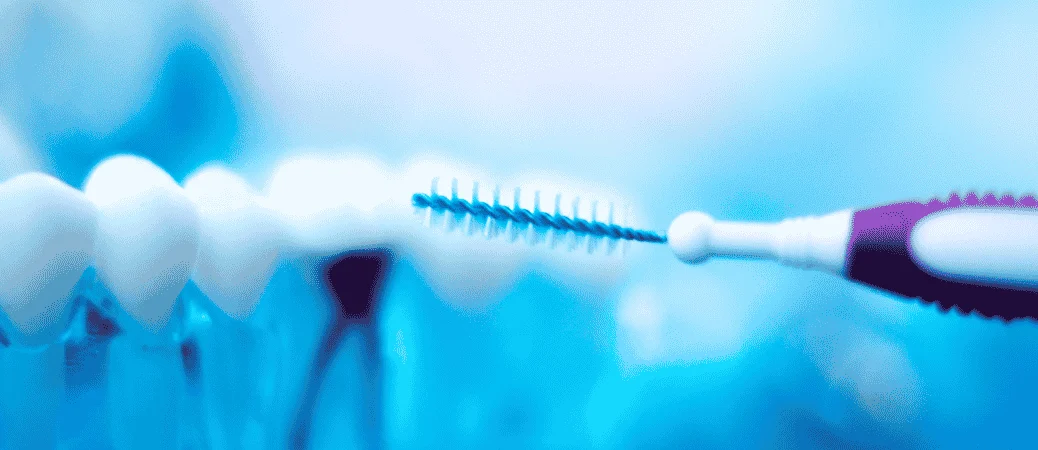
Implants don’t get cavities, but the gum and bone around them can get infected. That’s why knowing how to care for dental implants for long-term success is important for protecting the tissues that support them.
Your daily routine should include:
- Brushing twice a day with a soft brush
- Interdental brushes or floss threaders around each implant
- A water flosser under bridges and fixed dentures
- Nightly cleaning of any removable denture
See your hygienist every three to six months. They’ll check for bleeding on probing, plaque buildup, and early bone changes on X-rays.
Smoking and uncontrolled diabetes raise your risk, and both also slow implant healing in older adults.
Costs, Dental Insurance, and Questions to Ask Before Committing
A single implant with a crown often runs $3,000 to $6,000. Full-arch treatment can reach $20,000 to $50,000 per jaw.
Medicare doesn’t cover implants. Many dental insurance plans pay a share of the crown or denture, but cap annual benefits around $1,500 to $2,500, so understanding what affects cost helps you plan ahead.
Some private dental insurance plans add implant coverage after a waiting period.
Ask your dentist:
- Do I need a bone graft or sinus lift, and what does that add?
- How many implants do you recommend, and why that number?
- What’s included in the quoted price?
- How does my bone density affect candidacy?
- Who handles repairs, and what’s the warranty?
Frequently Asked Questions
Most people over 60 want to know the same things: whether age disqualifies them, how long healing really takes, and what could get in the way of success.
Here are clear answers about candidacy, timelines, success rates near 95%, and the health factors your dentist will check before surgery.
Am I too old to get dental implants after age 60?
No. There is no upper age limit for implants, and healthy adults in their 70s and 80s get them regularly.
Your dentist cares much more about your bone quality and general health than your birth year. Age alone doesn’t disqualify you from treatment.
What matters is whether your jawbone can hold an implant, whether your gums are healthy, and whether any medical conditions are under control. If your jawbone has thinned, a bone graft can often build it back up first.
Are dental implants worth it for seniors?
For many people, yes. Implants stay in place while you eat, so you can chew foods that dentures make difficult, like apples and steak.
They also help protect your jawbone. When a tooth is missing, the bone underneath starts to shrink, and an implant helps support jawbone health by giving that bone a job to do again.
The trade-off is cost and time. Implants cost more upfront than a bridge or denture, and treatment takes several months. Many patients still find the long-term value worth it because implants can last decades with good care.
How long does recovery take for dental implants in older adults?
The soft tissue part is fast. Swelling and soreness usually peak around day three to five, then fade over the next week or two.
The longer part is osseointegration, when your jawbone fuses to the implant post. That normally takes three to six months, and healing in older adults may run closer to four to six months before the final crown goes on.
That extra time is not a warning sign. It just reflects slower bone cell turnover, and your dentist will confirm with X-rays before moving forward.
Do dental implants have a high success rate after age 60?
Yes. Research shows survival rates above 95% in patients over 65, which is very close to what younger patients see.
Older studies and newer ones point in the same direction. Age by itself is not a strong predictor of failure.
What does predict problems is smoking, uncontrolled diabetes, poor gum health, and skipping daily cleaning around the implant. Those are the areas worth focusing on if you want the best odds.
What health conditions can affect implant healing and success?
A few conditions and medications need attention before surgery:
- Diabetes: high blood sugar slows tissue repair and raises infection risk
- Osteoporosis: thinner bone may call for grafting, and bisphosphonate drugs need review
- Heart and circulation problems: less blood flow means less oxygen reaching the healing site
- Autoimmune conditions: treatment may change how your body responds to the implant
- Blood thinners and steroids: these can affect bleeding and bone healing
Smoking is the habit with the biggest effect. It narrows blood vessels and clearly increases the risk of implant failure.
None of these automatically rule you out. Overall health and bone quality matter more than age, and most of these issues can be managed with planning.
What should I know before choosing dental implants as a senior?
Start with a full workup. Expect X-rays or a CT scan of your jaw, a review of every medication you take, and possibly blood tests to check things like vitamin D and blood sugar.
Ask about the total timeline, not just the surgery date. If you need a graft or an extraction first, the process stretches out, and bone density affects your candidacy in ways that change the plan.
Plan for nutrition too. Getting enough protein, calcium, vitamin C, and vitamin D gives your body the materials it needs to build bone around the implant.
Finally, get clear on cost and coverage before you commit. Many practices answer common questions about pricing and alternatives during the consultation, and it’s fair to ask how implants compare to a bridge or partial denture in your specific case.