If you’re researching all on x dental implants candidates, the main factors include how many teeth you’re missing, your jawbone health, and whether your gums and overall health can support implant surgery.
Many people with bone loss, old dentures, or a history of gum disease may still qualify after a thorough evaluation.
Many adults who have lost most or all teeth in an arch may be candidates for All-on-X. However, eligibility depends on a dental examination, imaging, bone support, oral health, and medical factors that affect healing.
All-on-X dental implants use a small number of implants to hold a full row of teeth. It is a type of full-arch tooth replacement, and the plan is built around your mouth.
Key Takeaways
- Missing or failing teeth across an arch is the clearest sign you may qualify.
- Gum disease and limited bone often delay treatment without ruling it out.
- Only an exam and CBCT scan can confirm your candidacy and implant plan.
Who Is All-on-X Designed For?
All-on-X is built for people who need to replace a whole arch of teeth and want those teeth fixed in place.
If your tooth loss affects nearly every tooth in your upper or lower jaw, or your teeth are breaking down faster than repairs can keep up, you fit the typical profile.
Are You Missing Most or All Teeth in an Arch?
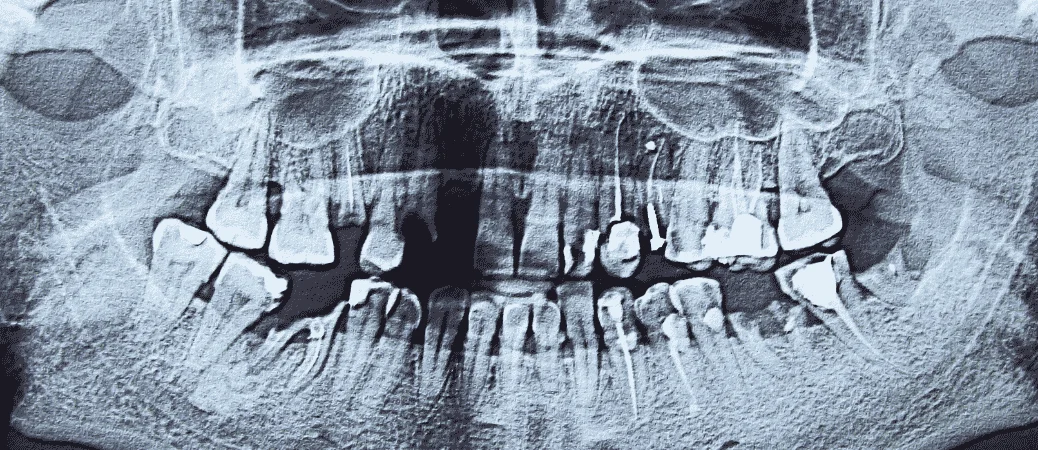
This is the most common sign. If you have only a few teeth left in one jaw, or none at all, full-mouth tooth replacement with implants may make more sense than saving a handful of teeth.
Replacing each missing tooth with its own implant would mean many surgeries and a high cost. All-on-X uses a few well-placed implants to support a full arch instead.
If you only have a few gaps, a smaller option like teeth implants for multiple missing teeth may fit you better.
Are Your Remaining Teeth Failing?
You do not need to be missing every tooth to qualify. Many patients still have teeth, but those teeth are loose, cracked, or badly decayed.
Common causes of failing teeth include:
- Advanced gum disease that has weakened the bone around your teeth
- Deep decay that keeps coming back after fillings
- Old crowns, bridges, or root canals that keep breaking down
- Teeth that have shifted or become loose
When teeth have a poor long-term outlook, your dentist may suggest removing them and starting fresh with a full arch on implants.
Do You Want Fixed Teeth Instead of Removable Dentures?
If you wear traditional dentures, you may know the daily hassle: slipping, sore spots, adhesive, and foods you avoid. Removable dentures rest on your gums, so they can move when you chew or talk.
All-on-X teeth are screwed onto implants. You do not take them out at night. If you want teeth that feel steady and let you eat a wider range of foods, that goal alone is a strong sign this kind of tooth replacement is worth exploring.
Do You Have Enough Jawbone to Support Implants?
Your jawbone is the base for every implant, so bone volume and density help decide your plan. Even with bone loss, angled implants or bone grafting often make treatment possible.
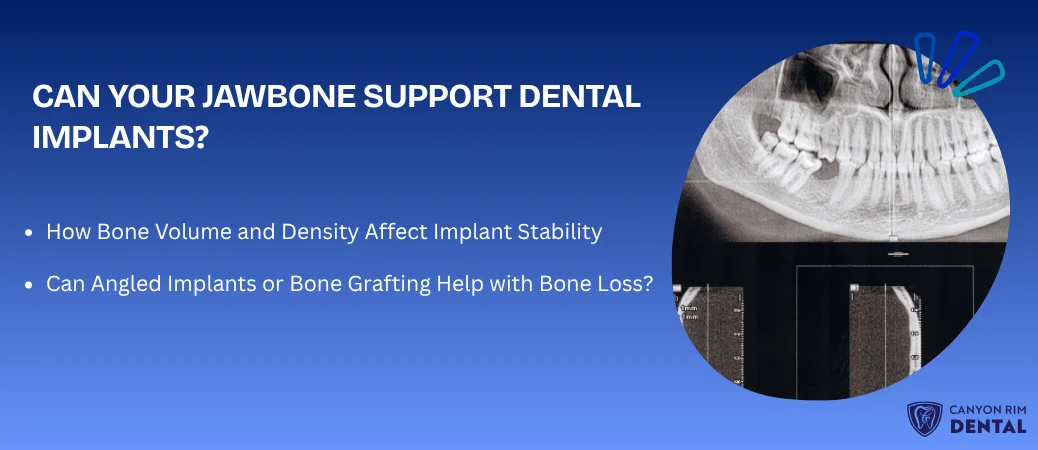
How Bone Volume and Density Affect Implant Stability
Implants need bone on all sides to stay firm. Your dentist looks at the height, width, and density of your jawbone at each spot where an implant might go.
Dense bone gives an implant a strong grip on day one. Softer, more porous bone may need a different implant design or a longer healing time.
Good implant stability at placement is one reason some patients can get temporary teeth the same day.
Bone loss starts once teeth are gone, because the jaw no longer gets pressure from chewing. Gum disease and years of denture wear speed this up.
You can read more about how bone density for dental implants is measured and why it guides implant placement.
Can Angled Implants or Bone Grafting Help with Bone Loss?
Yes, in many cases. With All-on-X, the back implants are often tilted so they reach into thicker bone toward the front of the jaw. This lets your dentist use the bone you still have and avoid grafting.
When bone is too thin even for angled implants, bone grafting can rebuild the area first. Grafting adds healing time, sometimes a few months, before implants go in.
In the upper jaw, severe bone loss may call for other methods, such as implants anchored in the cheekbone. These are more involved, and your scan shows whether you need them.
Are Your Gums and Overall Health Ready?
Healthy gums and a body that heals well are just as important as bone. Gum infection, some medical conditions, and smoking can slow osseointegration (the process where bone fuses to the implant), so these get handled before surgery.
Why Active Gum Disease Needs Attention First
Active gum disease is a “not yet” factor, not a “never” factor. The bacteria behind it can remain in your mouth after teeth are removed, increasing the risk of implant complications, including peri-implantitis.
Understanding the connection between dental implants and gum disease helps explain why healthy gums matter before surgery.
Your dentist will check for signs of gum disease, such as bleeding, swelling, and gum recession, before recommending treatment.
This may mean a deep cleaning, removing teeth that cannot be saved, or other gum treatment.
Once the infection is controlled and your gums are stable, your dentist can determine when implant surgery can move ahead.
Which Health Conditions, Medications, and Habits Affect Healing?
Certain medical conditions, medications, and lifestyle habits can increase the risks of implant surgery or affect healing.
Uncontrolled diabetes, tobacco use, medications affecting bone metabolism, and some immune-related conditions require careful evaluation.
Your dentist may coordinate with your physician to determine whether treatment is appropriate.
| Factor | Typical effect on your plan |
| Well-controlled diabetes | Usually not a barrier |
| Uncontrolled blood sugar | Delays surgery until levels improve |
| Smoking | Higher risk; quitting is strongly advised |
| Bone-related medications | Need review with your doctor first |
| Active infection | Treated before implants |
Be open about every medicine you take, including bone drugs for osteoporosis. If you smoke, see how dental implants for smokers are planned and why quitting before and after surgery helps.
Can You Commit to Daily Cleaning and Follow-Up Care?
All-on-X implants cannot get cavities, but the gums and bone around them can still get infected. You will need to clean under and around your new teeth every day with tools like a water flosser and special brushes.
You will also need regular dental checkups so your dentist can assess your gums, implant stability, and bite.
Professional cleaning around the restoration is important, and removal of the prosthesis may be recommended when clinically necessary.
How Will a Dentist Confirm Your Candidacy?
You cannot judge your own candidacy in a mirror; a dentist confirms it with an exam, a health review, and a 3D scan. From there, they build a plan that sets the number of implants and any prep work you need.
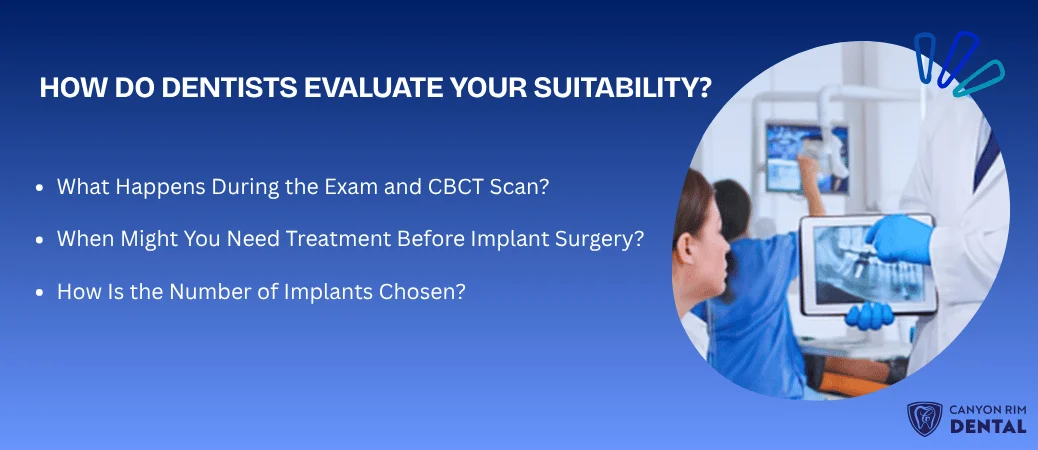
What Happens During the Exam and CBCT Scan?
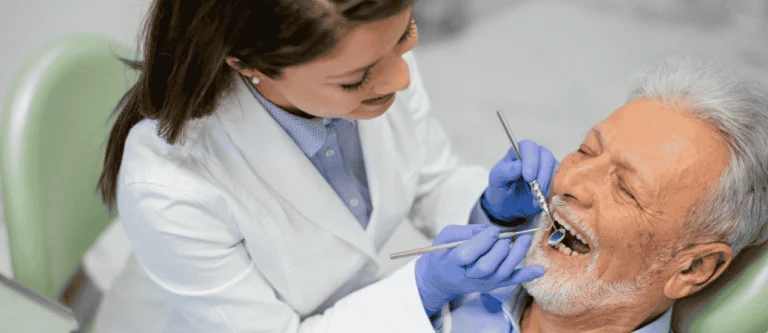
Your consultation usually starts with a talk about your health history, medicines, and goals. Your dentist then checks your gums, any remaining teeth, and your bite.
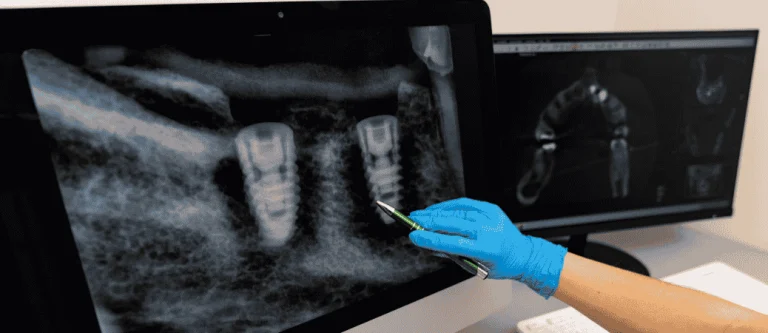
Next comes a CBCT scan. This is a 3D X-ray that shows:
- Bone height, width, and density
- The location of your sinuses in the upper jaw
- The nerve path in your lower jaw
- Hidden infections or damaged roots
The scan lets your dentist plan each implant digitally before surgery. Bring your list of questions; these questions to ask the dentist about All-on-4 apply to All-on-X too.
When Might You Need Treatment Before Implant Surgery?
Some patients need prep steps first. Common ones include:
- Tooth extraction of teeth that cannot be saved, often done the same day as implant placement
- Gum treatment to clear active infection
- Bone grafting when the scan shows too little bone
- Medical clearance to get blood sugar or other conditions under control
These steps add time, but they set you up for a steadier result. If extractions are part of your plan, knowing what to expect during a dental extraction can ease your nerves.
How Is the Number of Implants Chosen?
Most full arches use four to six dental implants, and the count depends on your bone, jaw shape, and bite force. All-on-4 places four implants.
All-on-6 dental implants add two more, which spreads chewing forces across more support.
The number of implants depends on available bone, implant positioning, bite forces, and the design of the final restoration.
Using additional implants may help distribute chewing forces, but it does not guarantee that the restoration can remain functional if an implant fails.
What Should You Expect If You Qualify?
If you qualify, the all-on-x procedure usually moves in two stages: temporary teeth while you heal, then a stronger final set a few months later.
Can You Receive Temporary Teeth on Surgery Day?
Many patients leave surgery with a fixed temporary prosthesis attached to their new implants. This depends on your implants gripping the bone firmly at placement.
Not everyone gets same-day teeth. If your bone is soft, or you need grafting first, your dentist may wait. You may wear a removable denture during healing instead. Your exam decides which path is safer for you.
During the first weeks you will eat soft foods to protect the healing implants. This guide to surgery recovery for All-on-X covers what to expect day by day.
When Is the Final Prosthesis Placed?
Your final prosthesis goes in once your implants have fused with your jawbone, often after several months.
Your gums also change shape during healing, so the final replacement teeth are made to fit your mouth after it settles.
Final teeth are often made from stronger materials like zirconia. Your dentist adjusts them for comfort, looks, and bite before locking them in place.
How Does All-on-X Compare with Dentures?
| Feature | All-on-X | Traditional Dentures |
| Stays in place | Fixed to implants | Rests on gums |
| Removed at night | No | Yes |
| Chewing strength | Much stronger | Limited |
| Helps preserve jawbone | Yes | No |
| Upfront cost | Higher | Lower |
| Surgery needed | Yes | No |
Implant-supported teeth let most people eat a wider range of foods and speak with more confidence. Dentures cost less and skip surgery, so they still suit some people.
Full arch implant restorations have shown long-term survival rates, which is why many patients see them as a lasting full-mouth restoration.
Finding the Right Path to a Fixed Smile

Your clearest signs of candidacy are missing or failing teeth across an arch and a wish for fixed teeth. From there, a dentist checks three things: your jawbone, your gums, and your health.
Gum disease, limited bone, and certain uncontrolled health conditions may delay implant treatment.
Some patients can become eligible after gum treatment, bone grafting, or medical management, while others may need a different tooth replacement option.
Your next step is a consultation with an exam and CBCT scan. Bring a list of your medicines and your goals for eating and smiling.
That visit gives you a real answer and a plan for your full-arch tooth replacement with dental implants.
Frequently Asked Questions
Am I too old for All-on-X dental implants?
No, there is no upper age limit for All-on-X. Your general health and healing ability count far more than your birth year, and many patients are in their 60s, 70s, and older.
Can I qualify if I’ve worn dentures for years?
Yes, long-term denture wearers often still qualify. Years of missing teeth do cause bone loss, but angled implants or grafting can work around it.
Your CBCT scan helps your dentist assess the available jawbone and plan possible implant placement.
Do I need to remove every remaining tooth?
Not always. If some teeth are healthy and others are failing, your dentist will weigh a full arch against options that save good teeth. Teeth with a poor outlook are usually removed so the full arch has a clean, healthy base.
What makes someone a poor candidate for All-on-X?
A poor candidate has health problems that block healing and cannot be brought under control. Examples include heavy smoking a person will not stop, uncontrolled diabetes, or being unable to keep up daily cleaning.
Missing teeth and bone loss alone rarely rule you out.
Can my body reject All-on-X implants?
True rejection is rare, since titanium works well with the body, and a titanium allergy is uncommon. Implant failure more often comes from infection, smoking, or poor healing.